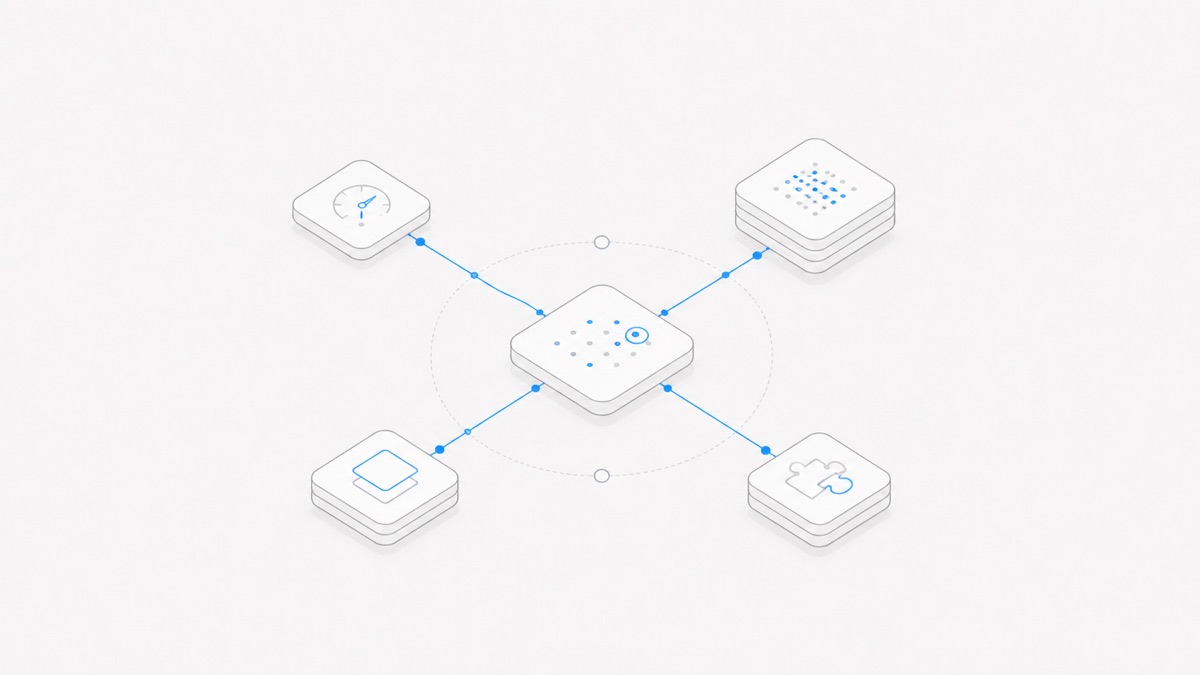
There is no single best coding agent model for every repository, harness, budget, and risk level. The useful choice is the compatible model that reliably passes your acceptance checks with an acceptable balance of total cost and latency—with a stronger or more deliberate route available when the task is ambiguous, long-running, or costly to get wrong.
That conclusion cannot come from a leaderboard alone. Start by defining the work, eliminate models that cannot support the required harness, inputs, tools, or reasoning controls, and then compare the remaining candidates on representative tasks. Measure completed work, repairs, and review effort, not just the price of one request.
The short rule: filter first, then test
Use four gates, in this order:
- Compatibility: Can the exact model-provider route work with your chosen agent harness, input types, and required controls?
- Task fit: Does it have enough capability and usable context for the work and its error cost?
- Operational fit: Are latency, availability, access path, and expected total cost acceptable?
- Evidence: Does the model pass the same real-task checks often enough to become a default?
The order matters. A highly capable model is not a candidate if the harness cannot call it or the route cannot accept an image the task requires. A low per-token price is not a saving if repeated failures create more model calls and reviewer work.
This article focuses on the model decision. If the execution layer is still unclear, first read why an agent harness and a model are different choices. A model supplies reasoning and generation; the harness controls how context, tools, permissions, and execution are organized around it.
Start with the task, not the model catalog
Model catalogs change. A task profile is more durable. Write down five properties before opening a selector:
- the expected deliverable;
- the files, systems, and input modalities involved;
- how much repository-wide or domain reasoning is required;
- how quickly the worker can receive feedback from tests or a reviewer;
- the consequence of a plausible error.
That separates work that only looks similar under the broad label “coding.”
These are routing hypotheses, not claims that one model tier always wins a category. A small but unfamiliar bug may demand more reasoning than a large, repetitive migration. A good task brief should therefore include an objective, scope, acceptance checks, and stop conditions before it names a model.
Translate the task into capability requirements
Turn the task profile into capabilities you can observe. A repository investigation may need strong evidence synthesis and disciplined tool use. A screenshot-to-code task needs image input. A schema migration needs instruction following across many related files, while a review task needs reliable criticism rather than a large patch.
Separate five questions:
- Can the model understand every required input type?
- Can it reason across the amount and kind of evidence the task contains?
- Can it produce the code, review, or structured output the harness expects?
- Can it propose tool calls accurately enough for this workflow?
- Does it follow scope and stop conditions when the evidence is incomplete?
A provider's capability label helps create the shortlist. Only the controlled task trial can show whether that capability survives the actual prompt, harness, tools, and runtime.
Apply the hard compatibility gates
“Available from the provider” does not mean “works in this coding agent.” Compatibility belongs to the complete route from harness to provider to model.
Check at least these gates:
- Protocol: Does the harness support the provider interface used by the model route?
- Input modality: Does the task require text only, images, or another input type?
- Output and tool behavior: Can the route produce the structured tool requests or other outputs the harness expects?
- Reasoning controls: If the workflow depends on a reasoning mode or effort control, does the integration support it in an executable form?
- Product availability: Is the exact combination currently enabled for the account, region, plan, and product surface you will use?
Agent.Space applies compatibility profiles after a harness is selected. Those profiles consider contracts such as protocol, modality, and supported reasoning behavior; the live selector is the final source of truth for combinations available in the product at that moment. It is not safe to infer a combination from a model vendor's catalog alone.
Provider documentation is still useful for the model side of the check. OpenAI's current model catalog exposes model-specific context, pricing, modalities, and tool support. Anthropic publishes both a model overview and a selection guide that balances capability, speed, cost, and testing. xAI likewise keeps model-specific details in its current models documentation. Treat those pages as changing specifications, not values to memorize forever.
Treat context as a budget, not a quality score
A larger context window answers a capacity question: how much input and output can fit within a request or session contract? It does not prove that every included token will be relevant, weighted correctly, or used well.
Estimate the working set the task actually needs:
- instructions and acceptance criteria;
- relevant code, schemas, logs, or images;
- tool results accumulated during the run;
- room for the model's output and any reasoning representation;
- headroom for corrections or a final validation turn.
Then inspect how the harness assembles that material. A repository index, search tool, or good retrieval policy may let a smaller working set outperform a huge unfiltered dump. Conversely, a model with adequate nominal context can still fail if the harness omits the decisive file or compacts away an earlier constraint.
Long sessions introduce another variable: context management. Record whether the harness summarizes, discards, or reloads earlier evidence. If a task regularly needs more context than the route can use reliably, the answer may be to split the work, improve retrieval, or create an explicit handoff artifact—not automatically to buy the largest published window.
Compare cost per accepted result
Per-token price is an input to cost, not the result. For a coding workflow, a more useful measure is:
You do not need perfect accounting to make this useful. Track a small set of observable quantities:
- model and provider usage for the full task, including retries;
- elapsed time until the acceptance checks pass;
- the number of manual corrections or additional prompts;
- reviewer time spent finding and fixing problems;
- failed runs that produced no usable artifact.
Latency also has two meanings. Time to first response matters during interactive pairing, while time to a verified final result matters for delegated work. A faster first answer can still be slower overall if it creates several repair loops.
Access and billing paths can change the economics even when the model name looks similar. Agent.Space separates Share and Flex, and model vendors update prices, plans, and limits independently. Check the current product and provider pages when cost affects the decision; do not base a routing policy on an old comparison table.
Run a controlled model trial
A useful evaluation changes the model while holding the rest of the workflow as steady as practical. Select three to five tasks from recent real work, including at least one easy task, one normal task, and one failure-prone task.
For each run, record:
Reset the code state between candidates. Let each harness expose the same required tools, but do not pretend provider-specific controls have identical semantics. Record a difference instead of forcing false equivalence.
Score the artifact before judging the conversation. Did the diff stay in scope? Do the tests pass? Were unsupported assumptions called out? Can another person reproduce the result? A fluent explanation is useful, but it cannot substitute for the acceptance evidence.
For an example of a decision constrained to one current model family, see the Sol, Terra, and Luna comparison. Its labels will eventually change; the controlled-trial method above should not.
For the current frontier release, start with the GPT-6 Astra coding-agent guide for the release, rollout, and capability map. Then use the Astra benchmark audit to see which public numbers are comparable, or the Astra vs GPT-5.6 Sol decision guide when the question is whether a difficult Sol workload justifies a higher-priced route.
Turn the result into a routing policy
Do not crown a permanent winner. Convert the evidence into a small routing policy that tells a team where to start and when to escalate.
One practical policy has three lanes:
- Fast lane: bounded, reversible work with deterministic checks starts on the lowest-cost route that has passed those tasks.
- Deep lane: ambiguous, repository-wide, or long-chain work starts on the model that passed the comparable reasoning tasks reliably.
- Escalation lane: high-consequence work adds stricter permissions, independent validation, and human review regardless of model strength.
Write the escalation triggers explicitly. Examples include two failed repair cycles, unexplained changes outside scope, missing evidence, tool-call errors, or a task entering a protected area. This prevents a cheap route from consuming unlimited retries and prevents a strong route from receiving unlimited authority.
Rerun a small benchmark when a provider changes the model snapshot, a harness changes its context or tool loop, a price changes enough to affect routing, or your task mix changes. The policy is a maintained operating decision, not a model identity.
Use the live Agent.Space selector as the final check
In Agent.Space, begin by choosing the Agent harness that matches the execution workflow. Then use the current model selector to see which models are compatible with that harness and access path. The selector, not this article or a vendor announcement, determines what can be started now.
From the remaining choices:
- select the lane that matches the task and its error cost;
- use a bounded prompt with explicit acceptance checks;
- inspect the saved artifact and validation evidence;
- record whether the route should remain a default, be limited to a task class, or be removed.
The method does not assume Agent.Space has benchmarked every visible model, and visibility is not a quality endorsement. It gives you a repeatable way to generate your own evidence while the catalog changes.
Review the current Agent Hub when you are ready to choose a harness first, then test one compatible model on a task you can verify.