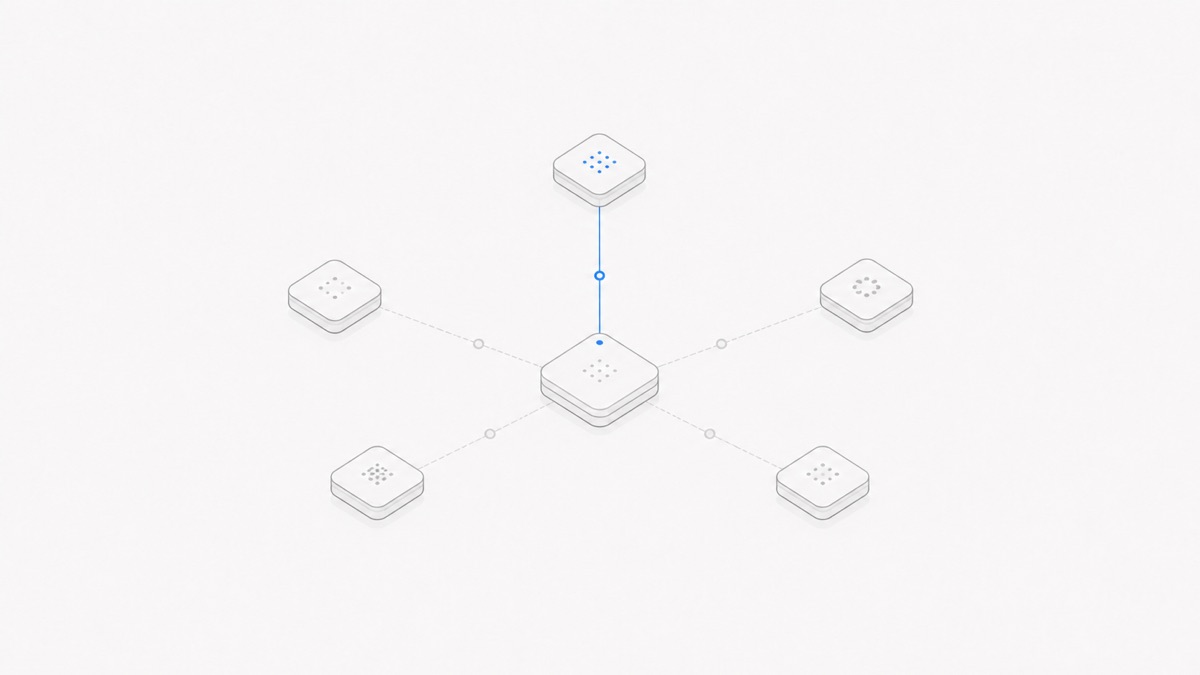
One API key for multiple AI models can reduce credential sprawl and centralize usage visibility. Here, “one key” means one unified gateway credential per environment or workload boundary—not one unrestricted company-wide master key. It does not make model IDs, API protocols, tool calls, streaming events, state, rate limits, errors, or outputs interchangeable.
A safe migration treats the key and base URL as the smallest part of the change. Freeze the current contract, build a capability matrix, run representative evaluations, canary a small share of traffic, and preserve rollback until the new path has survived real load.
What one key simplifies—and what it does not
A unified key can simplify:
- how many credentials a service stores;
- rotation and revocation at the gateway boundary;
- model discovery from one account;
- request-history and spending review;
- onboarding for clients the gateway explicitly supports.
It does not automatically unify:
- OpenAI Responses and Anthropic Messages request shapes;
- model-specific tools, context limits, or structured output;
- streaming and error events;
- conversation state and caching behavior;
- provider rate limits and data controls;
- authorization inside the coding Agent's tools or workspace;
- output quality for your repository tasks.
The Agent.Space Developer API guide documents current key creation, model discovery, and supported client paths. This article begins after that setup decision and focuses on migration safety.
1. Freeze the current contract
Before changing anything, capture the behavior production depends on:
- endpoint and protocol;
- authentication header and key owner;
- exact model IDs and aliases;
- request parameters and defaults;
- system instructions and conversation-state strategy;
- tool definitions, call IDs, results, and side effects;
- streaming event types and ordering assumptions;
- timeout, retry, and cancellation behavior;
- rate-limit headers and backoff;
- usage fields, pricing source, and budget alerts;
- error types your application handles;
- data retention, region, and logging requirements.
Save representative raw requests, sanitized responses, and expected business outcomes. This becomes the migration contract and rollback reference. Do not store live secrets in the fixture set.
The OpenAI Responses reference and Anthropic Messages reference show why a base-URL replacement is insufficient: the two APIs represent state, content, tools, and results differently.
2. Build a capability matrix
Create one row for every model you intend to expose and one column for every required capability:
Use “unknown” until a source or test proves a cell. A model appearing in discovery proves that it is addressable; it does not prove that every client feature works with it.
Keep model access separate from the Agent harness and workspace layers. A key can fund a model call, while the harness still owns the multi-step loop and the workspace owns files, processes, and durable project state.
3. Separate credentials from authorization
Reducing the number of upstream keys should not create one credential with unlimited reach.
- Create a dedicated key for each environment or workload boundary.
- Keep keys in a server-side secret store, never browser code or a repository.
- Record the owner, purpose, creation date, and rotation plan.
- Limit which service can read the key.
- Keep tool authorization separate: a model gateway credential should not automatically grant database, shell, deployment, or production-write access.
- Verify revocation with a real rejected request.
Use the coding Agent workspace security checklist for filesystem, network, secrets, and approval boundaries. Gateway consolidation is not a substitute for least privilege inside the Agent runtime.
4. Normalize model discovery and routing
Treat live model discovery as the source of truth for what the account can request. Store the provider-returned model ID alongside any friendly name shown in your UI.
Avoid silent aliases during migration. If default-coding-model changes from one underlying model to another, log the resolved ID and make the change reviewable. Otherwise a quality or cost change can look like random drift.
Define routing behavior explicitly:
- Which model handles each workload class?
- Is fallback allowed, and for which errors?
- Can fallback cross model families or protocols?
- Does a fallback repeat a tool with side effects?
- Which balance or account funds the resolved model?
- How does the user learn that a different model ran?
Agent.Space currently separates Share- and Flex-funded models and does not automatically use one balance to cover the other. The Share versus Flex guide explains that boundary. Verify current funding and availability in product materials and request history rather than inventing a failover rule.
5. Run representative evaluations and cost checks
Build a sanitized evaluation set from real work:
- repository questions;
- a scoped code change with tests;
- a tool call with valid and invalid arguments;
- a long-context task;
- a task that requires an approval;
- a recoverable provider error;
- an attempted forbidden action.
Define acceptance before running the models. Useful checks include tests passing, requested files changing, protected files remaining untouched, tool schemas validating, no duplicate side effect, and human approval of the final diff.
Record resolved model, protocol, calls, retries, latency, usage categories, estimated cost, tool failures, and operator interventions. Do not call models “compatible” because both returned plausible text once.
6. Canary the cutover and preserve rollback
A canary sends a small, controlled share of eligible traffic through the new path while the previous path remains available.
Start with reversible, low-risk work. Compare the canary against predeclared thresholds:
- accepted-task rate;
- tool-call validation failures;
- retry and timeout rate;
- latency distribution;
- cost per accepted task;
- rate-limit events;
- security or policy violations;
- manual interventions.
Keep a rollback switch that restores the previous endpoint, credentials, model mapping, and adapter. Test that switch before the migration, not during the first incident. For side-effecting tools, make retries and rollback idempotent so a repeated request does not repeat a deployment, payment, or destructive write.
7. Retire old keys only after observation
After the canary expands, observe at least one representative usage cycle. Confirm that scheduled jobs, low-frequency tools, alternate regions, and recovery paths have used the new route.
Then retire old access deliberately:
- stop creating new traffic on the old path;
- search configuration and secret stores for remaining references;
- revoke the old key at its owner;
- verify that a request with it fails;
- keep non-secret audit metadata and the migration record;
- remove obsolete adapter and fallback code once rollback is no longer required.
Leaving an unused credential active “just in case” keeps the old attack surface without providing a tested recovery path.
A copyable go/no-go checklist
- Current requests, responses, models, tools, errors, usage, and limits are documented.
- Every required capability has official evidence or a passing representative test.
- The new key is scoped, stored server-side, named, and revocable.
- Tool and workspace authorization remain least-privilege.
- Model IDs are discovered live and resolved IDs are logged.
- Routing and fallback behavior are explicit; side effects are idempotent.
- The same evaluation set passes agreed quality and safety thresholds.
- Cost is calculated from complete tasks, not one response.
- A small canary has run under realistic concurrency.
- Rollback has been tested.
- Old credentials are revoked only after the observation window.
Go only when every required item has evidence. One key is valuable when it simplifies operations without hiding model and protocol differences. To review the current dual-protocol entry point and live account options, open the Agent.Space Developer API before designing the cutover.