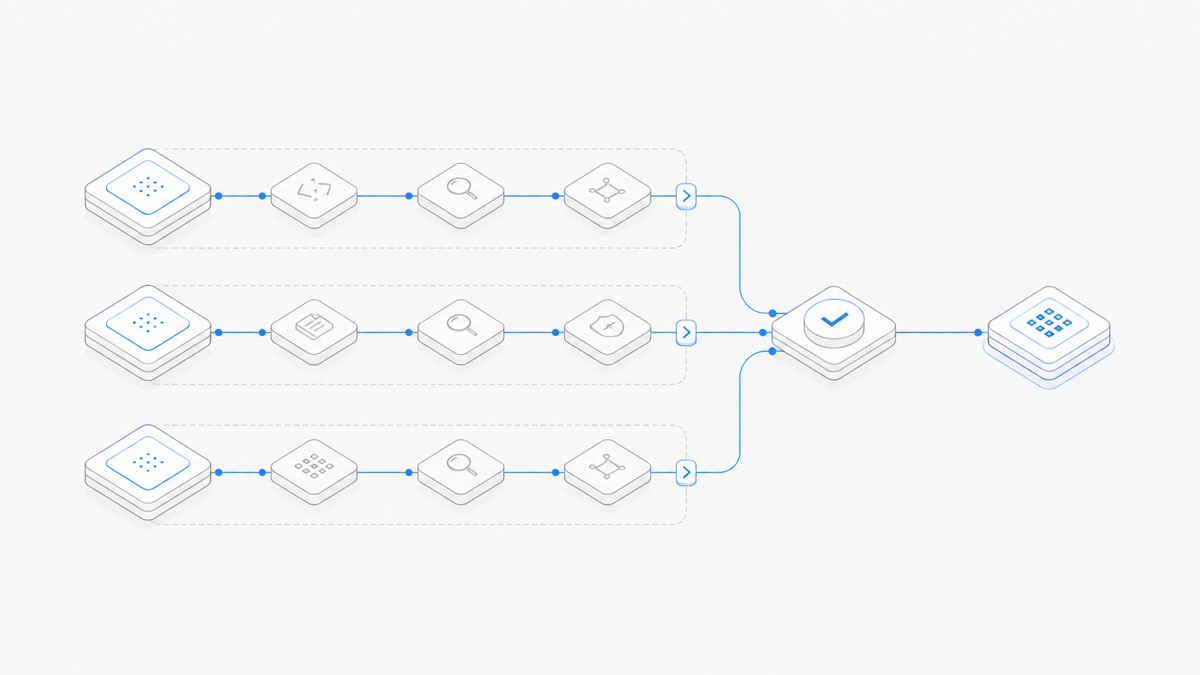
A useful multi-agent coding workflow does not begin by opening as many Agent Sessions as possible. It begins by defining one result, splitting the work along clear ownership boundaries, and deciding which tasks can safely run at the same time.
The practical rule is simple: parallelize independent investigation and edits; serialize decisions and changes that touch the same contract, file, or source of truth. Keep every result inspectable, then place a human review gate before the work is accepted.
Agent.Space can keep multiple Agent Sessions, saved files, Queues, and Previews in one cloud Workspace. That shared environment makes coordination visible, but it does not automatically assign work, create a private branch for every Session, or merge conflicting edits. The workflow still needs an owner.
When multiple coding Agents are worth using
More Agents help when the work contains genuinely separable jobs. Good candidates include:
- mapping two independent parts of a codebase;
- implementing a bounded change while another Session prepares test cases;
- finishing an implementation before an independent review;
- producing separate artifacts that meet at a defined interface;
- investigating alternative explanations without changing the same files.
Multiple Agents add little value when the next step depends on one unresolved decision, several tasks must rewrite the same files, or nobody can review the combined result. In those cases, extra concurrency turns one uncertain task into several uncertain tasks.
The goal is not maximum parallelism. It is shorter time to an accepted result without losing control of scope, evidence, or the current project state.
A five-stage multi-agent coding workflow
Use the following sequence whether the participants are Codex, Claude Code, OpenCode, other supported harnesses, or a mixture of people and Agents.
1. Define the outcome and acceptance gate
Write the result in terms a reviewer can check. “Improve authentication” is too broad. “Reject expired reset tokens, preserve valid-token behavior, and pass the named regression test” has a finish line.
Record four things before assigning work:
- the expected result;
- what is explicitly out of scope;
- the command, Preview, diff, or artifact that proves completion;
- who decides whether the result is accepted.
This shared brief prevents separate Sessions from inventing different versions of the task.
2. Split work by output and write boundary
Each work item should produce an identifiable artifact: a code change, test, investigation note, review report, or decision comparison. Give every item a write boundary as well as a topic.
For example:
“Work on the backend” is not a useful boundary. A named module, file set, or read-only responsibility is much easier to coordinate.
3. Assign ownership and choose the sequence
Every item needs one owner. Other Agents can advise or review, but only one participant should own the current edit boundary.
Then mark the dependency:
- Parallel: the outputs are independent and do not modify the same source of truth.
- Sequential: one output must be accepted before the next begins.
- Parallel research, sequential decision: several Sessions can investigate, but one person selects the direction before implementation.
If two tasks can both change the same interface or shared file, treat them as sequential unless you have real branch isolation and a deliberate merge plan.
4. Run the work and preserve evidence
An Agent explanation is not the project state. Ask each owner to leave inspectable evidence with the files:
- the exact files changed or examined;
- the commands and tests run, including failures;
- a working Preview when the output is visual;
- assumptions that affected the implementation;
- known risks and the next recommended action.
In Agent.Space, different Sessions in one Workspace can run in parallel, and later input to a busy Session remains visible in its Queue. They still operate against one current file state. A Session does not silently inherit another Session's conversation or private reasoning, so important decisions must be written into shared artifacts rather than left implicit.
5. Review, reconcile, and accept
Bring the outputs together only after their individual evidence is ready. The review gate should check:
- whether each result matches the original acceptance criteria;
- whether combined edits contradict one another;
- whether an assumption changed while parallel work was running;
- whether the final tests cover the integrated state, not just isolated pieces;
- whether the diff contains unrelated changes or unnecessary complexity.
Run the relevant validation again after reconciliation. Tests that passed before another Session changed the same project are not proof that the current state passes.
Example: Codex implements, Claude Code reviews, OpenCode repairs
Suppose a team needs to fix a checkout calculation and add a regression test.
- A person defines the failing scenario, expected total, excluded refactors, and required test command.
- A Codex Session owns the implementation and test files for the bounded fix.
- After the patch and test evidence are saved, a separate Claude Code Session performs a read-focused review against the original requirement and current diff.
- If the review finds one precise defect, an OpenCode Session receives that finding, the current files, and a narrow repair boundary.
- A person reviews the final diff and runs the complete acceptance check before merging or publishing.
This is sequential where state matters, even though it uses three Agent harnesses. The second and third Sessions can inspect the saved project files and explicit handoff artifacts, but they do not inherit the implementer's hidden reasoning. The separation is valuable because the reviewer receives evidence and a fresh job, not because one harness is assumed to be universally better.
If you are still deciding which harness should implement or review, use the Codex vs Claude Code workflow comparison as a decision framework rather than a permanent ranking.
Decide what should run in parallel
Use parallel execution when the cost of later reconciliation is low.
Parallel work is most effective when the coordination note is shorter than the conflict it prevents.
Treat file ownership and version control as separate controls
A Workspace gives the team one visible place to work; version control gives the project history, comparison, rollback, and merge boundaries. They solve different problems.
Within one shared file tree:
- give every active writer a non-overlapping scope;
- do not assume each Session has a private copy;
- pause work when a shared contract changes;
- inspect the current diff before accepting another write task;
- use repository branches or isolated copies when two alternatives must change the same files independently.
Agent.Space does not describe multi-Session collaboration as an automatic commit, merge, or rebase workflow. If a project needs those guarantees, use its version-control process deliberately.
For a person-to-person continuation after the Agent work, follow a team handoff built around files, evidence, and roles. For higher-risk repositories, establish Workspace isolation, permission, and secret boundaries before increasing concurrency.
Budget review attention, not only Agent capacity
Each additional Agent produces more material for someone to understand. That review cost is part of the workflow.
Set stop conditions before starting:
- stop an investigation when it can identify the relevant path and support a decision;
- stop implementation when the acceptance criteria pass, not when every nearby file has been improved;
- stop parallel work when two Sessions begin touching the same contract;
- stop and ask for a human decision when the requirement, data boundary, security assumption, or architecture direction changes.
A good multi-agent workflow can use fewer Agent turns than an unbounded single-Agent task because it assigns each participant one clear job. A poor workflow multiplies speculative edits and then spends more time reconciling them.
Start with the smallest reproducible workflow
For the first run, use one bounded project task and no more than two active responsibilities:
- write the outcome, exclusions, and acceptance check;
- assign one implementation boundary;
- assign one independent review after the candidate is stable;
- preserve the diff, test output, Preview, decisions, and open risks;
- let one person accept or reject the combined result.
Only add parallel implementation after that sequence works. The measure of success is not how many Agents were active. It is whether another person can inspect the current state, understand why it is acceptable, and continue without reconstructing the project.
Use Agent.Space when you want the supported Agent Sessions, saved files, Previews, and team context in one Workspace. Start with one real task, keep ownership explicit, and add parallelism only where the boundaries stay clear.